
From first-generation university student to doctoral researcher championing place-based research, local voices and community knowledge
Friday 16, October 2026
When Dr Stuart Greensmith White successfully completed his PhD without any corrections, he achieved something very few researchers do.
For Stuart, however, the achievement is about much more than earning a doctorate. It’s the story of someone who originally didn’t have the chance to go to university becoming a researcher whose work shines a light on the experiences of young people growing up in Nottinghamshire’s former coalfield communities.
Despite extensive professional experience and strong prior educational attainment, a PhD was never part of Stuart’s plan.
A doctorate wasn’t something I’d considered as academia felt distant in my home community. Paid PhD opportunities are very hard to come by. It’s really difficult if you don’t have the know-how or the connections.
Before starting his PhD, Stuart completed an apprenticeship degree while working. He had never seriously considered doctoral study until he spotted a funded PhD opportunity through the Collaboratory Research Hub online just a few days before applications closed. Stuart would go on to join Collaboratory’s first Nottingham PhD cohort, becoming one of the programme’s inaugural researchers.
What attracted him was the way the programme focused on individual lived experience.
They wanted to know about the person, your interests, your qualities, your connection to the local community. It was very person-centred.”

Staurt and his Academic Co-Supervisor, Chris Rolph
Understanding What ‘Work-Ready’ Really Means
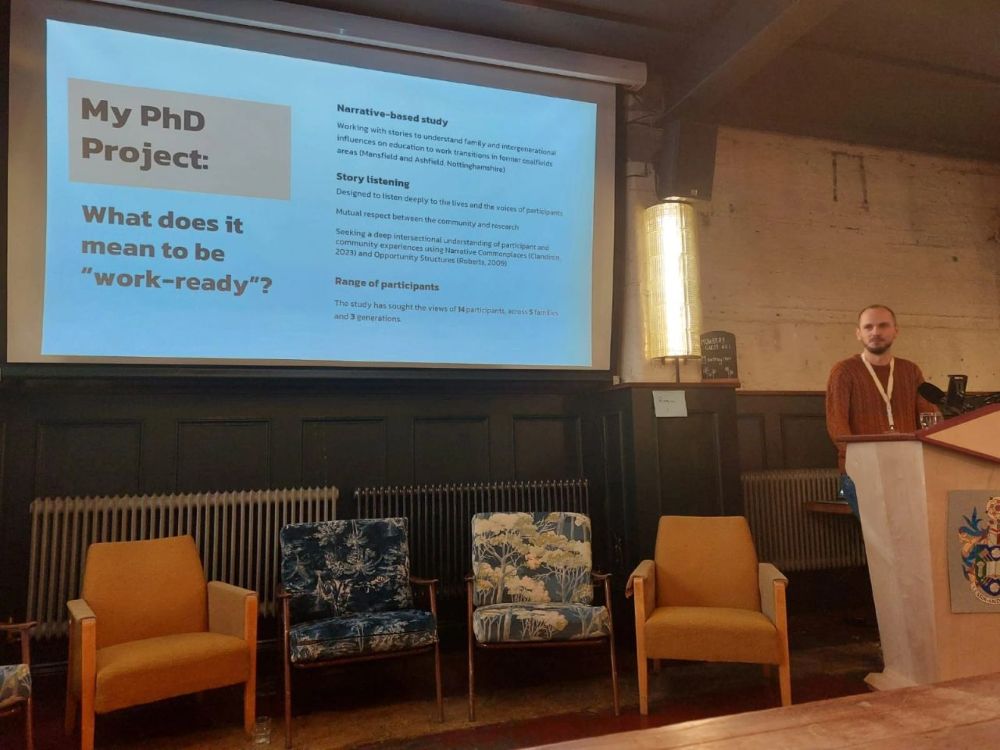
Stuart’s PhD explored a simple but important question: what does it really mean to be work-ready?
His research focused on young people living in former coalfield communities and used stories to understand how they move from education into employment. Taking a place-based research approach by speaking to multiple generations within families, he explored how family experiences, local opportunities and community connections influence young people’s ambitions and choices.
The work was closely connected to Stuart’s long-standing interest in improving opportunities for young people across Ashfield and Mansfield. Alongside his research, he contributed to initiatives that brought together educators, employers and community partners to better understand how young people prepare for work and what support they need to succeed.
Drawing on his own experiences of living, working and growing up in the area, Stuart wanted to ensure local voices remained at the centre of the conversation.
It’s about hearing their stories and truly valuing local experience. It’s not about judgement but sharing their experiences so that people beyond the communities understand what it’s like to live here and grow up here.
At the heart of his research was a desire to understand the support available to young people before, during and after they leave education. By identifying both the factors that help them thrive and the challenges they face, he hopes his work can help shape local policy and practice, creating better opportunities for future generations.
His findings strengthened the importance of understanding communities on their own terms rather than relying on deficit-based assumptions.
What works in Nottingham might not work in Mansfield or Sutton. Local distinctions are huge.
For Stuart, recognising those local differences is essential to developing solutions that genuinely meet the needs of young people and their communities.
Supported by Community
Throughout his PhD, Stuart worked alongside university colleagues and community partners who shared his commitment to improving opportunities for local people.
I’m very lucky. I was supported by a first-class team who genuinely care about the area.
That support helped him develop not only as a researcher but also as a professional. Around halfway through his doctoral journey, new opportunities began to emerge, including work as a casual lecturer at Nottingham Trent University’s Mansfield campus.
The experience allowed him to combine research, teaching and community engagement while continuing to develop the skills and relationships that had shaped his work from the beginning.

Stuart with his Viva Examiners
Looking Ahead
Completing his PhD marks the end of one chapter, but Stuart is already considering how his research can continue to make a difference.
While I am immensely proud to have completed my doctorate, the core work is far from finished. My focus is now on ensuring the narrative findings are shared widely to directly inform local practice and initiatives to support productive education-to-work transitions. I aim to build on my doctoral research, keeping the stories and voices of young people and their families at the very centre of emerging debates of how we support transitions into the workplace.
Rigorous, impactful community research relies on the building of trustful, ethical, and mutually respectful working relationships. I aim to collaborate with local educators, charities, employers and policy authorities who recognise one-size-fits-all approaches to employability do not work in former industrial areas. By utilising the power and personality of stories and lived experience, I am keen to work with organisations who want to design practical actions in support of employability while remaining rooted within local communities.
I welcome conversation and connections with practitioners, educators, policymakers and fellow researchers with interests in vocational and work-based education, narrative research and in social justice. Discussions of the thesis findings, future collaborative projects or the practicalities of engaged narrative community research are welcome. Contact can be made via email stuart.greensmithwhite@ntu.ac.uk or Linkedin
An Achievement That Goes Beyond a PhD
Completing a PhD without corrections is a rare achievement and reflects the quality of Stuart’s work. His story demonstrates that deep community connections and lived experience are an asset to impactful research.
As the first candidate of Collaboratory to have summited and defended his PhD thesis and the first in his family to attend university, Stuart’s journey highlights the importance of equitable access to higher education and research. He is also the first candidate to organise a viva examination at NTU’s Mansfield Campus. His work has helped build a deeper understanding of the experiences, challenges and ambitions of young people in Nottinghamshire’s former coalfield communities while demonstrating the value of research rooted in local knowledge and lived experience.
For Stuart, the PhD represents more than an academic qualification. It demonstrates what can happen when people with strong connections to their communities lead research with local impact. His journey shows that local voices not only deserve to be heard but can play a vital role in shaping research, policy and making positive change.
By Alex Nkrumah